
To achieve your video marketing goals, you must be strategic with your message, video length and how
you plan to use a variety of videos to support your entire sales funnel. Furthermore, you need a process
for tracking the success of your videos in order to measure ROI and understand where you can improve
your efforts.
1) Use Shorter Videos for More Effect
The more your customers can learn in a short amount of time, the more likely they’ll get to know your product and services better than your competitor’s. To keep your audience hooked on your page instead of moving on, don’t use long and dense videos right off the bat.
You might be inclined to showcase everything your service or product has to offer within one video, but it’s simply ineffective. Your videos should compel customers to move forward in the buyer journey, not stop them in their tracks.
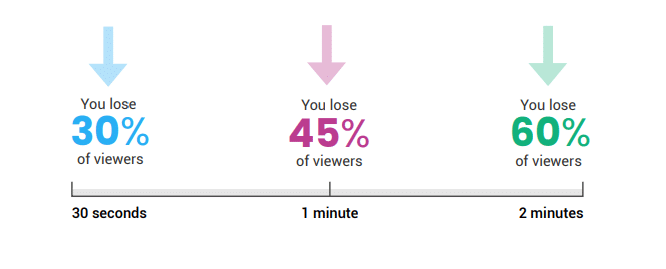
Prospects will watch short videos and work their way through your funnel if they can do it in small effective chunks.
Average viewership Stat Graphic:
Example Video Lengths:
Explainer videos:
Anywhere from 45-90 seconds.
How-to Videos:
Should solve the problem in 1-3 minutes.
Short Form Video Ads:
Anywhere from 15-20 seconds.
Demo Videos:
Can be a little longer but shouldn’t be over 10 minutes.

You need to make your videos short and to the point. Get to what you’re trying to solve as quickly as possible while still delivering genuine, insightful, and helpful information to your viewers.
– Derek Gerber, Head of Product and Marketing, Explainify
2) Use Video Throughout the Entire Sales Funnel
The days of using one video for anything and everything are gone. Instead, companies that have success with video use strategic videos at all stages of the sales funnel. By understanding their funnel and how video supports the journey through it, companies shorten their conversion time while increasing conversion rates.
A big win for many companies is being able to clarify what they actually do at the top of the funnel. Since B2B software and deep-tech can be highly complex and technical, video allows this tech to be broken down to an understandable level. This sets a great foundation for videos down the funnel to expand upon this baseline in a targeted way.
Since buyers are self-educating, there’s a lot of opportunity at the middle of the funnel and bottom of the funnel to enhance the buyer journey by providing more in-depth and relevant material.
View the infographic below for insight on which types of videos are effective at the different stages of the
sales funnel.

Our tech can easily become overwhelming for viewers, so videos have communicated our product value a lot faster and easier.
– Patricia La Bella, Marketing Communication Manager, ActivePDF (a PDFTron company)
Video as a strategy is supported by the top but also by the whole team. Everyone understands video is king.
– Trevor Pyle, Senior Product Marketing Manager, QuantumMetric
When you communicate something by video, you actually get to see facial expressions and understand information more clearly. More people are jumping in and choosing to absorb that content.
– Tabitha McFadden, Vice President of People Operations, RevUnit
3) Use Video as an Accelerant for Product Led Growth
Acquisition, activation, and onboarding are everything in a product-led growth model. When 40%-60% of users sign up for a trial and never come back, video should be leveraged to pull users through your funnel in a self-directed way.
Many companies target areas where users struggle with adoption and use video to enable them to move forward. They also provide videos around why users should take specific actions within a product and remove any technical barriers. Since video influences users to take critical actions sooner, the Time to Value Rate (TTV) speeds up.
To gain insight around what content to create, you can monitor user activity within free trials and freemium products to understand how to help users before even speaking with them. Providing support through video also helps to reduce churn and boost the Average Revenue Per User (ARPU).
Furthermore, onboarding can scale much faster when the focus is on activation instead of being dependent on CS teams. The goal with video here is to enable 1 CS rep to handle 10x their normal capacity.
Put video on your welcome page, email sequences, and within the product to convert users to Product Qualified Leads faster.
– Wes Bush, Author of Product-Led Growth
Use video to remove technical and procedural lift on the user’s end.
– Laura Smous, Sr. Director of Product Marketing, Adroll
Activation & Onboarding – that’s where all their leverage is!
– Garret Mehrguth, CEO, Directive
4) Tracking the ROI of Video
When you start increasing your investment in video and use it throughout your full-funnel, the types of metrics you care about and how you use viewership data changes. It’s no longer just about views, but how those views impact your KPIs (Key Performance Indicators).
When you use a quality video host such as Vidyard, they track viewership metrics for you which can then automatically be integrated with your CRM or Automation software. This way, you can gain insight into who watched which video(s) and how that influenced new leads, the amount of new pipeline, and new revenue generated.
When this data from individual accounts gets combined with your overall video analytics data, you can establish these following metrics:
1. Qualified Leads
The number of qualified leads generated by your video marketing efforts.
Details on Tracking: Your engagement data goes into contact records for accelerated lead qualification. When you track someone that watches 50% or more of a video, that account automatically gets sent over to the sales team for further review.
2. Influenced Pipeline
The impact your video has on qualified sales opportunities.
Details on Tracking: Once your leads are researched and qualified by your sales team, these leads now become part of your overall pipeline.
3. Influenced Revenue
The impact your video has on the amount of new revenue.
Details on Tracking: Take a look at which videos influenced the number of closed deals over a given amount of time. Then you can add up the total amount of new revenue generated in relation to the deals that closed through the influence of video.
For examples of this process in action, go check out our webinar co-hosted with Vidyard.